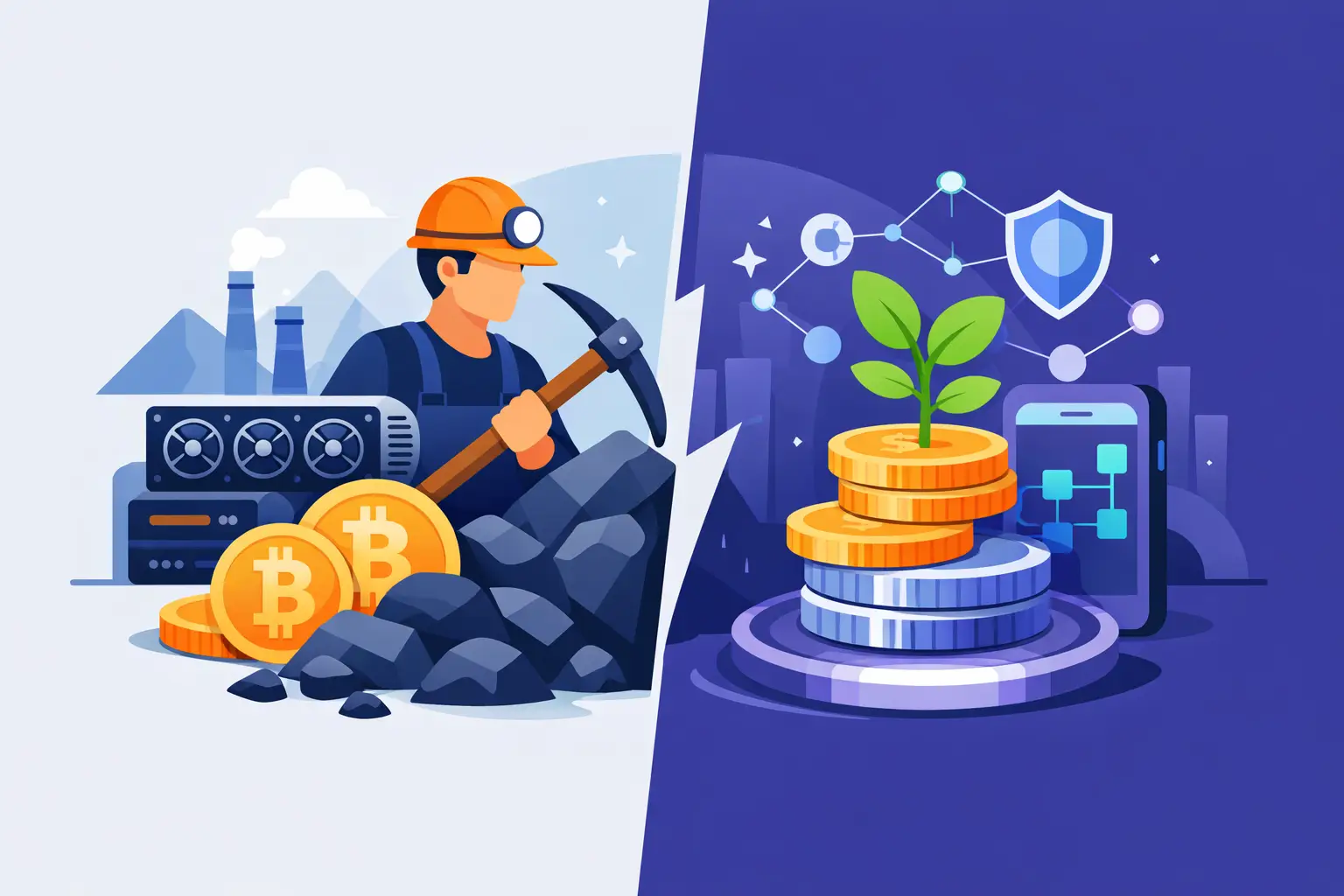
A lot of people searching bitcoin mining vs staking are really asking a simpler question: which path gives me a real shot at building extra income without getting lost in crypto jargon? That is the right question, because these two models may sound similar on the surface, but they play by very different rules.
If you are tired of trading hype for hope, this comparison matters. Mining and staking can both produce rewards, but they differ in ownership, risk, volatility, control, and long-term positioning. One is tied directly to Bitcoin’s proof-of-work network. The other usually involves locking up a different coin to help run a proof-of-stake blockchain. That distinction alone changes everything.
Bitcoin mining vs staking: the core difference
Bitcoin mining is the process of using computing power to secure the Bitcoin network and validate transactions. In return, miners earn rewards in bitcoin. Staking works differently. You commit or lock coins on a proof-of-stake network, and in exchange you earn yield or token rewards for helping support that chain.
Here is the part many beginners miss: you cannot stake Bitcoin on the Bitcoin network. Bitcoin uses mining, not staking. So when people compare bitcoin mining vs staking, they are usually comparing direct exposure to Bitcoin production versus earning rewards through an entirely different crypto asset.
That matters because if your conviction is strongest around Bitcoin itself, mining keeps your activity aligned with the biggest and most established digital asset. Staking may offer convenience, but in most cases you are stepping into altcoin territory, and that brings a different layer of risk.
Why people are drawn to staking
Staking looks attractive because it feels simple. Buy a coin, lock it up, and collect rewards. No mining hardware. No talk about energy costs. No need to think about machines, hashrate, or mining infrastructure. For someone just entering crypto, that lower barrier can feel like the easier road.
And sometimes it is. If your goal is passive exposure to a proof-of-stake asset you already believe in, staking can be a clean fit. Some platforms make the process almost automatic, which is appealing for people who want low effort and quick setup.
But easy does not always mean safer. Staking rewards depend on the token holding value, the health of the network, and the rules of the platform or validator you use. If the token drops hard, your yield may not save you. A 10 percent reward means very little if the asset falls 40 percent.
There is also platform risk. In some setups, your coins are locked for a period of time, or your control is reduced because a third party is involved. That may be acceptable to some investors, but it is not the same as building around Bitcoin’s mining model.
Why bitcoin mining stands apart
Bitcoin mining appeals to people who want exposure to the asset with the strongest brand, deepest liquidity, and longest track record in crypto. Instead of depending on a newer token economy, mining connects you to the engine that secures Bitcoin itself.
That has psychological value and strategic value. Many people are not looking for the next coin with a flashy promise. They want something they can explain to themselves clearly: I am participating in Bitcoin’s network, and my rewards are in bitcoin.
This is one reason mining keeps attracting entrepreneurs, side-hustle seekers, and people serious about long-term financial freedom. It is easier to build conviction when the model is straightforward. You are not chasing yield from a token you barely understand. You are focused on Bitcoin.
For the BTC Strateg audience, that difference is more than technical. It is practical. If your goal is to create another stream of income while positioning yourself around an asset with real staying power, mining can feel more grounded than staking a rotating list of altcoins.
Bitcoin mining vs staking on income potential
Income potential depends on your setup, your capital, your time horizon, and market conditions. There is no honest way around that. Anyone promising guaranteed results in either model is selling fantasy.
Staking often offers predictable-looking percentage returns, but those numbers can be misleading when the underlying token is unstable. The yield may look good on a dashboard while the asset itself trends down. That can leave you earning more units of something worth less.
Mining is not immune to market pressure either. Bitcoin price, mining difficulty, and operational costs all affect profitability. But the key difference is what you are accumulating. If you believe Bitcoin has stronger long-term upside and resilience than most altcoins, mining rewards can carry a different kind of value.
That is why this is not just about short-term percentage returns. It is about what you want to own over time. Plenty of people chase higher staking yields and end up holding weaker assets. Others prefer a model that may take more thought up front but keeps them aligned with Bitcoin.
Accessibility and the beginner question
For beginners, staking usually feels more accessible because it can start with a few clicks. Mining has a reputation for being complicated, expensive, and highly technical. That reputation is partly deserved, but it is also outdated in some cases.
Not everyone needs to become a hardware expert to participate in mining-related opportunities. The real issue is not complexity. It is whether you have trustworthy guidance and a simple onboarding path. When people get stuck, it is usually because no one translated the process into plain English.
That is where education matters. A beginner can handle mining if the steps are clear, the expectations are realistic, and the support is personal. In that environment, mining stops feeling like a secret club and starts feeling like a business model you can actually understand.
Staking still wins on immediate simplicity. Mining can win on clarity of purpose, especially if Bitcoin is the asset you want to build around.
Risk, control, and what you are really betting on
When you compare bitcoin mining vs staking, you are also comparing two different bets. With mining, you are betting on Bitcoin, network participation, and the economics of producing bitcoin over time. With staking, you are betting on a proof-of-stake token, its ecosystem, and often the platform handling your stake.
That does not make staking bad. It just makes the risk profile different. Some staked assets are established. Others are not. Some platforms are reliable. Others create counterparty risk that many beginners underestimate.
Mining has its own risks too. Costs matter. Timing matters. Efficiency matters. And if someone enters blindly expecting instant freedom, disappointment comes fast. The better way to see mining is as a serious strategy, not a magic button.
For people who want more control over their financial future, that distinction is powerful. Mining tends to attract those who want to build with intention. Staking tends to attract those who want easier entry and less friction. Neither path is perfect. The better fit depends on what kind of investor you are becoming.
Who should choose mining and who should choose staking
If you strongly believe in Bitcoin, want your rewards tied to Bitcoin, and care about building around the most recognized crypto network, mining makes more sense. It is especially attractive if you are thinking beyond quick gains and looking for a vehicle connected to long-term conviction, not just convenience.
If you are comfortable with altcoin exposure, want something simpler to start, and understand that high yields can come with higher token risk, staking may fit better. For some people, that trade-off is worth it.
But if your bigger goal is financial independence, not just collecting random crypto rewards, then focus on alignment. Choose the model that matches the asset, the risk level, and the future you actually want. A lot of people say they want passive income, but what they really want is momentum, ownership, and more control over their life.
That is why mining keeps standing out. It is not because it is effortless. It is because for the right person, it feels connected to something stronger than a yield number on a screen.
The smarter way to decide
Before you put money into either model, ask yourself three direct questions. Do I want exposure to Bitcoin specifically? Am I comfortable holding the coin involved if the market turns against me? And do I understand where my rewards actually come from?
Those questions cut through a lot of noise. They force you to look past marketing and focus on fundamentals. If you cannot answer them confidently, pause before committing capital.
Crypto gives people a chance to think bigger about income, freedom, and what is possible outside the traditional paycheck. But better opportunities come from better understanding. If Bitcoin is the asset you trust most, then building around mining may be the move that gives you not just earnings potential, but a stronger sense of direction.